
A Knowledge Management Maturity Model for Law Firms in the Age of AI
Law firms operate in a knowledge-intensive environment but lack a structured framework to assess and develop their knowledge management (KM) capabilities. This thesis develops a KM Maturity Model for Law Firms by extending the established General Knowledge Management Maturity Model.
Topic
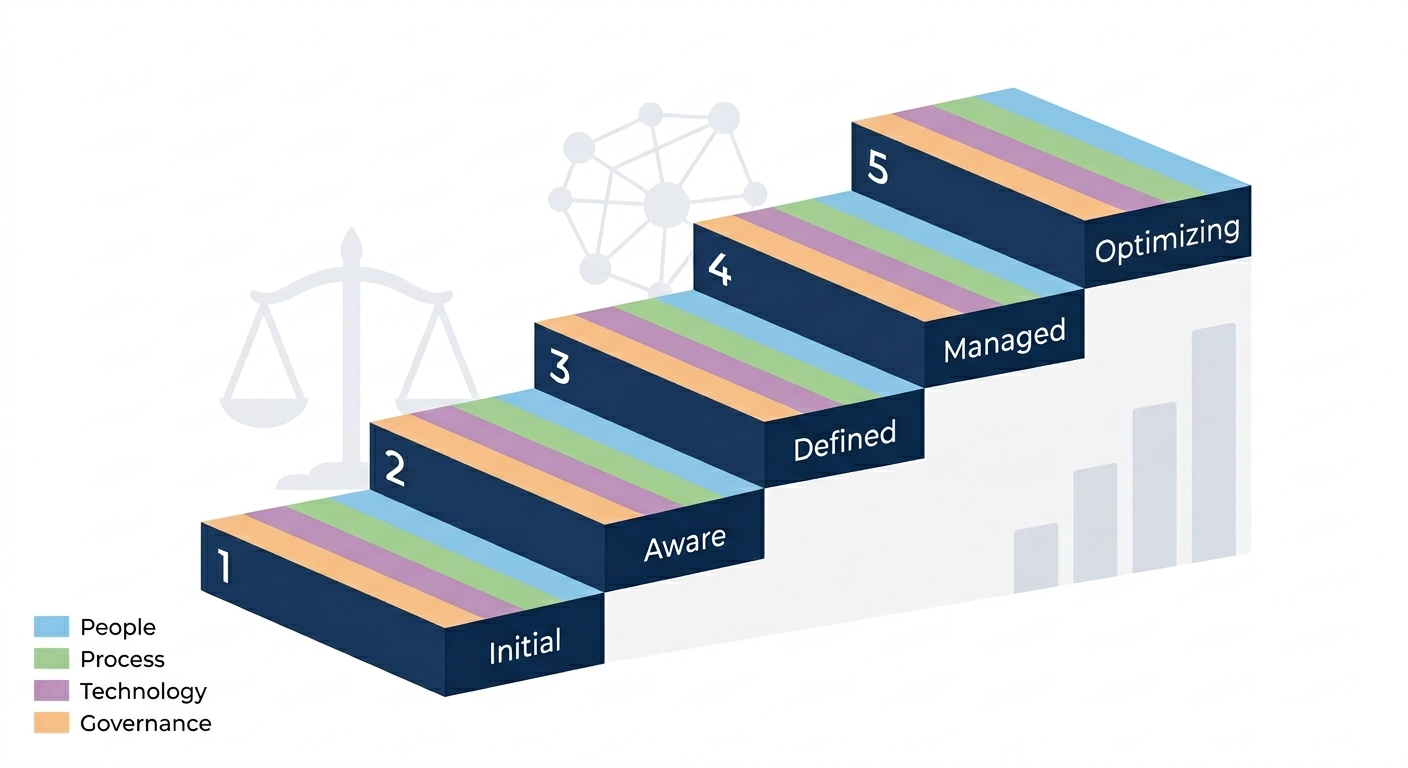
Law firms operate in a knowledge-intensive environment but lack a structured framework to assess and develop their knowledge management (KM) capabilities. This thesis develops a KM Maturity Model for Law Firms by extending the established General Knowledge Management Maturity Model (G-KMMM) of Pee and Kankanhalli (2009) with law-firm-specific adaptations across four dimensions, namely People, Process, Technology, and Governance. The resulting artifact serves as a diagnostic instrument that enables law firms to locate their current maturity and identify the steps needed to advance it.
Relevance
Knowledge is the core asset of any law firm, yet its management remains largely informal and person-dependent. Billable-hour pressure actively discourages knowledge sharing, and the rapid adoption of generative AI tools introduces governance risks that established KM frameworks do not address. A law-firm-specific maturity model closes this gap and gives practitioners a concrete, actionable instrument to assess and systematically develop their KM capabilities.
Results
The model describes KM maturity across four dimensions and five levels, namely Initial, Aware, Defined, Managed, and Optimizing. The three adapted dimensions embed law-firm-specific characteristics, including the billable-hour incentive structure, practice-group-based knowledge sharing rituals, and privilege-safe AI-assisted retrieval over firm-internal knowledge assets. The Governance dimension, newly constructed for this study, addresses policy, data classification, AI tool oversight, vendor management, and partner offboarding. Distinctively, it treats attorney–client privilege and the prohibition on processing client data in public LLMs as a Level 1 baseline whose absence disqualifies the firm from meaningful KM assessment.
Implications for Practitioners
- Privacy as baseline: Protecting client-privileged information and embedding privacy by design must be the starting point of any KM programme. Without these safeguards, every AI interaction risks an active breach of professional secrecy.
- Incentives beyond time codes: Anchoring KM contribution in performance evaluation is more durable than non-billable time codes alone, which experts described as existing "on paper but not lived" unless reinforced in promotion decisions.
- Practice-group rituals: Weekly updates, monthly practice-area sessions, and post-conference sharing are the dominant real-world mechanism for knowledge transfer in law firms.
- Training over policy drafting: Role-differentiated training on KM and AI policies separates leading firms from merely well-governed ones, as policies have little effect without active staff training and accountability.
- Apply the model directly: An operational self-assessment instrument implementing the KMMM-L is openly available in the project's OSF repository (file 04_Assessment_Instrument.xlsx). The instrument is self-administering and produces a diagnostic dashboard of the firm's current maturity level per dimension.
Methods
This research applied a five-phase Design Science Research methodology, based on Becker, Knackstedt, and Pöppelbuß (2009) and adapted by Defize (2020), to develop and evaluate the maturity model. The established G-KMMM framework served as the structural baseline, extended through a literature review on legal KM, AI adoption, and compliance. The initial artifact was evaluated through semi-structured expert interviews with practitioners from a cross-section of Swiss law firms, and the data was analyzed using qualitative content analysis following Mayring (2014). This feedback guided the iterative improvement of the model's dimensions and assessment criteria. Finally, a Think-Aloud phase confirmed the tool's practical usability and its logical relevance to real-world practice.