Design Principles in VR for Visually Impaired Users
Topic
Job interviews are a decisive and disproportionately demanding gateway into employment for blind and visually impaired people, yet existing technology-based preparation tools, immersive, sensor-based, and text-based alike, presuppose vision, down to their reflection layers. This Masterthesis therefore asks which design principles non-visual, multimodal Virtual Reality applications should follow to support learning and reflection in job interview preparation for blind and visually impaired users. It develops seven empirically and theoretically grounded design principles and evaluates them formatively through a VR prototype tested with blind and severely visually impaired adolescents.
Relevance
Around 103,000 people of working age in Switzerland live with a visual or deafblind impairment, around 13,000 of them blind (Spring, 2019). Despite equality legislation, their employment rates remain markedly below those of the general population, and the application and interview stage forms a particularly demanding barrier. For XR developers, accessibility specialists, vocational counselling, and rehabilitation institutions, this thesis shows how immersive training technology can be designed inclusively from the start. Its central message: for blind users, the conversation and the audio architecture are the system itself, not optional polish.
Results
The thesis presents seven design principles: a conversational core, a non-visual perceptual and interaction layer covering audio-first orientation, convention-aligned input, and progressive information management, bounded reflective learning, accessibility-standard parity, and transparency and data sovereignty. The evaluation provided initial support for the conversational core, confirmed bounded agent guidance as a completion condition, and exposed the speech pipeline as a technical precondition. The clearest failure, spatial orientation, occurred where the principle was least instantiated, corroborating it through absence. A tension between privacy protection and training authenticity tightens data sovereignty into an architectural requirement. The set constitutes a Level 2 Nascent Design Theory.
Implications for practitioners
- Design audio-first: for blind users, the conversation and the sound architecture are the system itself. Give them the design attention normally reserved for the visual interface.
- Spatial audio alone does not support wayfinding. Complement it with verbal, egocentric, and proactive guidance, for example "the interviewer is seated to your left."
- Bound the AI agent: cap follow-up questions and prioritize breadth before depth, because unbounded probing ended engagement in both interview and reflection.
- Treat the speech pipeline as a precondition, not a feature: latency, long utterances, and graceful degradation decide whether realism and reflection survive.
- Engineer privacy into the architecture: only local or training-free processing lets users practice with their real personal data without sacrificing authenticity.
Methods
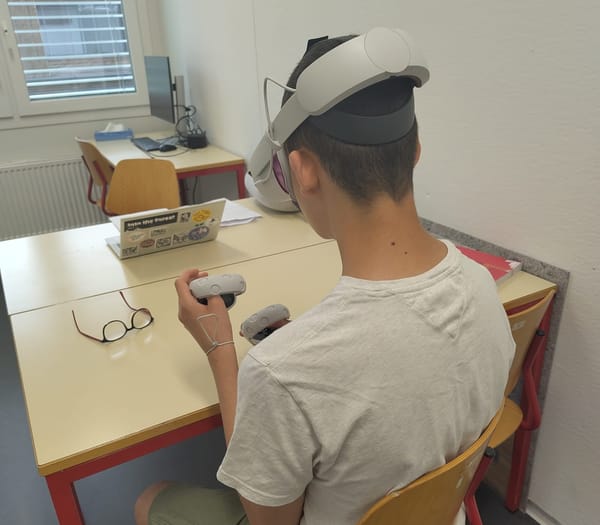
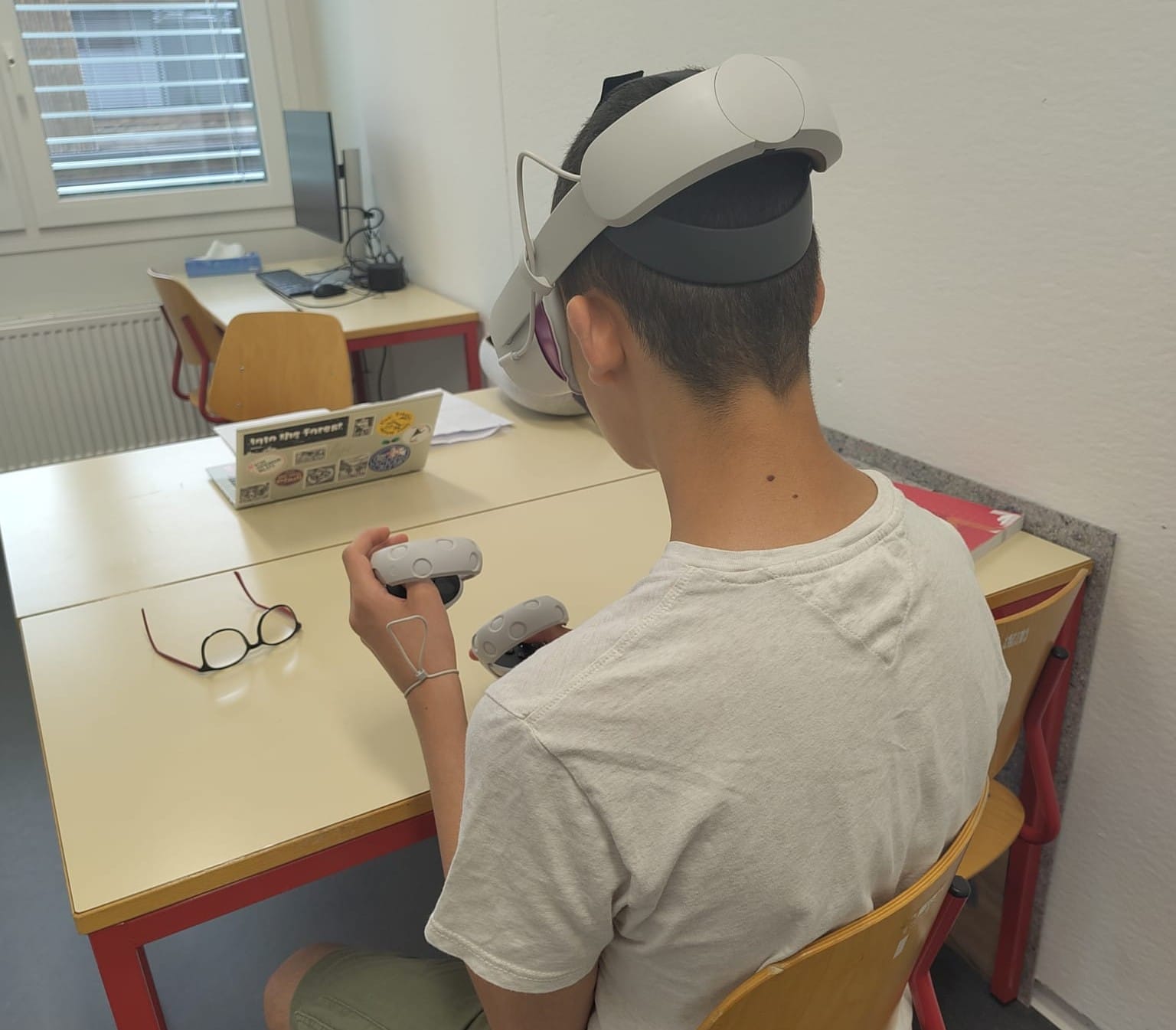
The thesis follows Design Science Research along Hevner's (2007) three-cycle model. In the Relevance Cycle, six semi-structured interviews with blind and visually impaired professionals yielded 15 User Stories; in the Rigor Cycle, a structured literature review (89 screened sources) produced 13 Literature Issues. The Design Cycle integrated both into seven design principles specified in the schema of Gregor et al. (2020). A VR prototype (Meta Quest 2), implemented by a third-party developer and partially instantiating the principles, was evaluated formatively following the FEDS framework.
Filtern nach: