
Understanding Consumer Trust in ChatGPT's Shopping Feature
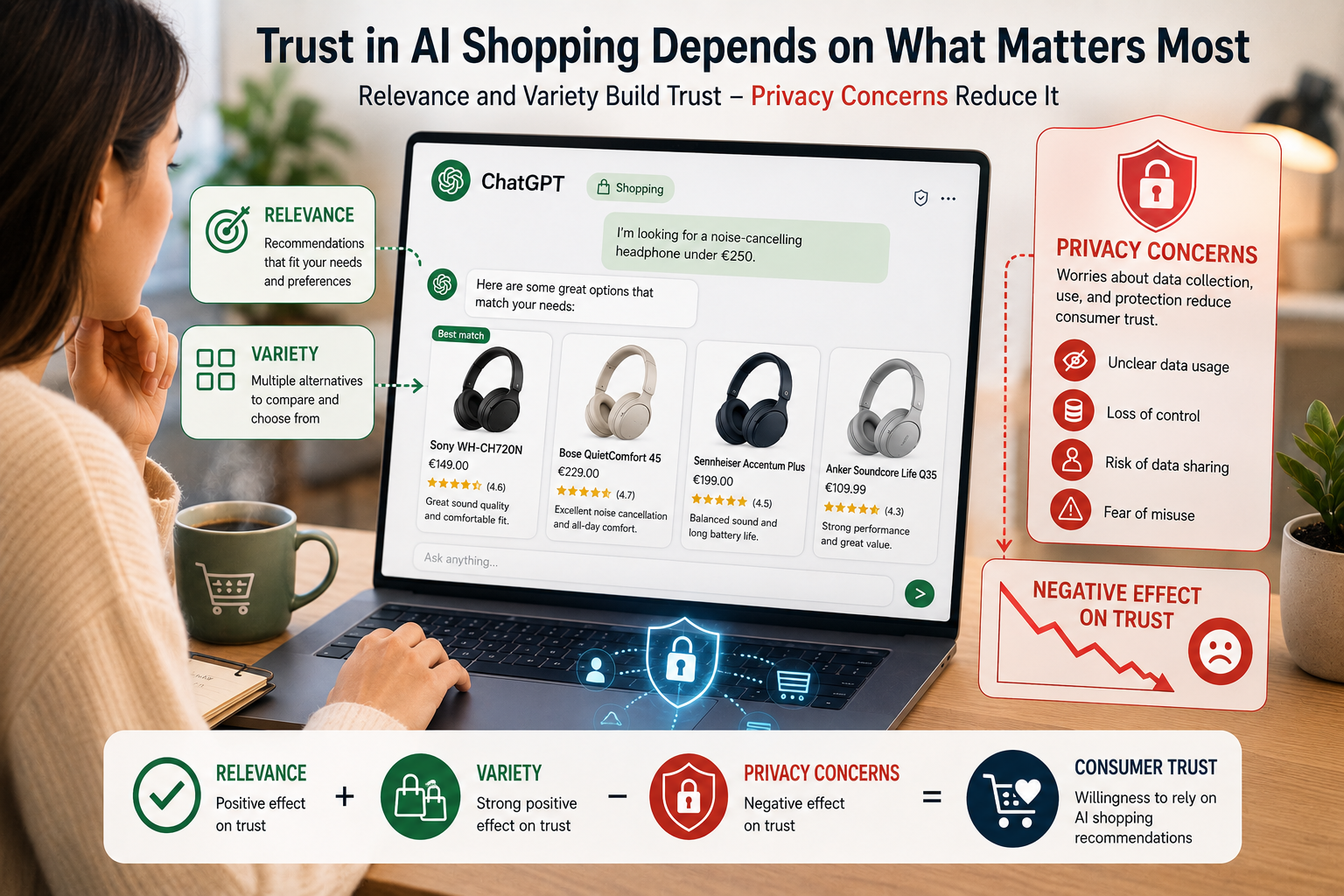
Can consumers trust AI-generated shopping recommendations? This study investigates how recommendation relevance and recommendation variety influence consumer trust in ChatGPT's shopping feature and whether privacy concerns shape the trust formation process in conversational commerce.
Topic
This study examines how consumers develop trust in ChatGPT's shopping feature. As conversational AI systems increasingly support product search, comparison, and evaluation, understanding the factors that influence trust becomes important for retailers and platform providers. The study investigates the effects of perceived relevance and perceived variety of AI-generated product recommendations on consumer trust and explores whether privacy concerns influence these relationships. The research contributes to the growing field of conversational commerce and AI-assisted shopping environments.
Relevance
Conversational AI is increasingly becoming part of the online shopping journey. Consumers can now discover, compare, and evaluate products through natural-language interactions rather than traditional search interfaces. As organizations invest in AI-powered shopping experiences, understanding how trust is established becomes critical. Trust influences consumers' willingness to rely on AI-generated recommendations in purchase decisions. This study provides practical insights for retailers, e-commerce platforms, and AI developers seeking to improve the effectiveness and adoption of conversational shopping systems.
Results
The results show that both perceived relevance and perceived variety positively influence consumer trust in ChatGPT's shopping feature. Among the examined factors, perceived variety emerged as the strongest predictor of trust. Privacy concern had a significant negative effect on trust, but did not moderate the relationship between recommendation relevance and trust. The findings suggest that consumers value both the quality of recommendations and access to multiple relevant alternatives when evaluating conversational shopping systems.
Implications for Practitioners
- Design conversational shopping systems that present multiple relevant product alternatives rather than focusing on a single recommendation.
- Improve recommendation quality by aligning product suggestions with users' expressed needs and preferences.
- Ensure product information is structured to improve discoverability within AI-generated recommendation environments.
- Communicate clearly how personal data is collected and used during AI-assisted shopping interactions.
- Address privacy concerns alongside recommendation performance when developing conversational commerce solutions.
Methods
This study employed a quantitative research design using an online survey administered through Qualtrics. Participants were required to watch a demonstration video of ChatGPT's shopping feature before completing the questionnaire to ensure a common understanding of the evaluated functionality. The final sample consisted of 151 valid responses from European consumers familiar with ChatGPT. Data were analyzed using descriptive statistics, Pearson correlation analysis, and hierarchical multiple regression. The study examined the effects of perceived relevance and perceived variety on consumer trust and tested whether privacy concern moderated the relationship between recommendation relevance and trust.