
Augmenting the Discovery Phase: Design and Evaluation of a Client-Facing Voice Agent for Requirements Engineering in Swiss Software SMEs
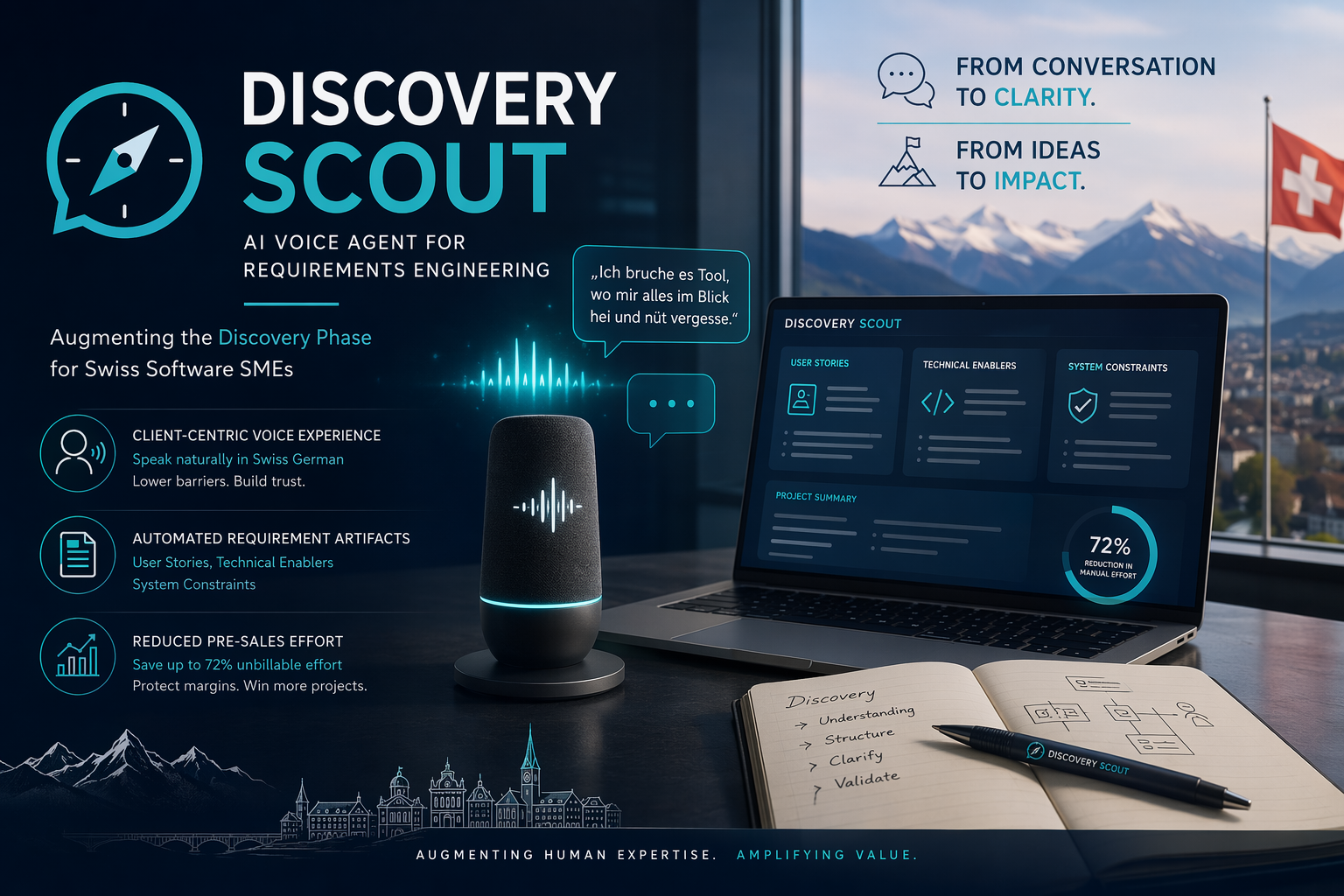
This master thesis designs and evaluates the “Discovery Scout”, a client-facing AI voice agent that helps Swiss software SMEs reduce unbillable pre-sales discovery effort by converting Swiss German client input into structured requirements while preserving the need for human technical refinement.
Topic
The Master's Thesis investigates the automation of the initial pre-sales discovery phase in software development for Swiss SMEs through a client-facing conversational AI agent. It systematically designs, implements, and evaluates the "Discovery Scout," a voice-enabled AI leveraging a Retrieval-Augmented Generation (RAG) architecture and advanced Speech-to-Text (STT) capabilities. This artifact enables clients to asynchronously articulate software requirements in their native Swiss German dialect. The goal is to transform unstructured verbal inputs into formalized agile artifacts, such as User Stories, thereby reducing manual elicitation efforts
Relevance
For Swiss custom software SMEs, the pre-sales discovery phase presents a significant financial bottleneck due to exceptionally high local labor costs. Competing on quality against international offshoring requires these SMEs to invest substantial unbillable hours to elicit vague client requirements. The proposed voice agent is highly relevant as it offers an efficient, low-threshold method to capture initial requirements without draining expensive project management resources. Furthermore, by mitigating "dialect bias" and lowering cognitive entry barriers, the system fosters conversational trust while protecting pre-sales profit margins.
Results
The evaluation demonstrates a profound economic impact, reducing unbillable manual elicitation efforts by an indicative 72%. The "Discovery Scout" saves an average of 20.68 human hours (equivalent to CHF 1,754) per project acquisition by automatically capturing a large share of initial requirements. However, the study also identified the "Hollow Shell" phenomenon: while the AI effectively captures high-level business narratives, it systematically lacks the strict technical depth and non-functional constraints required for an immediate engineering handoff. Therefore, the AI acts as an augmentation tool rather than a complete replacement for human expertise.
Implications for practitioners
- Reduction of Unbillable Effort: Deploying the voice agent significantly reduces expensive, unbillable pre-sales hours by shifting the Project Manager's role from manual transcriber to strategic reviewer.
- Enhanced Discovery Foundation: The AI-generated artifacts provide a highly structured and standardized first layer of formalization, creating a much stronger basis for subsequent in-person client workshops and technical discovery.
- Necessity of Human Oversight: Practitioners must recognize the "Hollow Shell" phenomenon; the AI successfully extracts business value but lacks deep technical edge-case definitions, requiring mandatory human refinement by Solution Architects before engineering handoff.
- Strategic Pre-sales Scalability: The automated tool supports more standardized and repeatable pre-sales work, helping Swiss SMEs scale their acquisition phase while protecting margins and maintaining high-context consulting quality.
Methods
The study adopts the Design Science Research (DSR) paradigm, iteratively traversing the Relevance, Rigor, and Design cycles based on Hevner's (2007) model. The artifact's design principles are formalized using the schema proposed by Gregor et al. (2020). For evaluation, the study employs the "Human Risk & Effectiveness" trajectory from the FEDS framework. To ensure ecological validity and prevent technical bias, non-technical surrogate clients tested the agent using native Swiss German dialects in fictional pre-sales scenarios. Subsequently, industry experts assessed the objective business utility and quality of the generated requirements using established frameworks.