From Score to Roadmap: AI Guidance Swiss SMEs Can Actually Use
Swiss SMEs can assess AI literacy in about 10 minutes, but usually receive only a score. This thesis develops and tests DigiBot 2.0, a free Swiss-hosted tool that converts results into ranked, sourced actions tailored to the firm’s size, sector, and employee role.

Topic
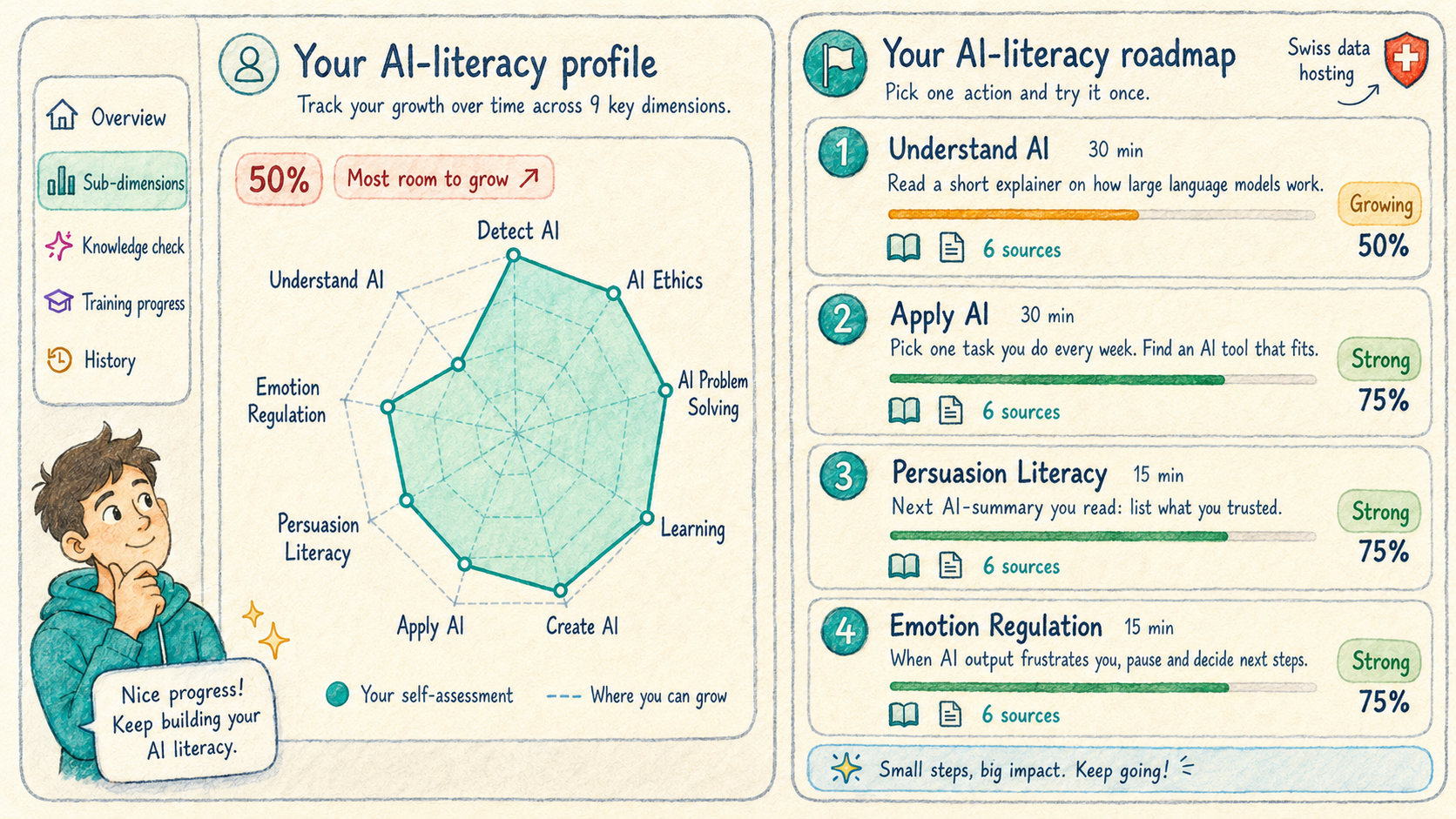
Your team already drafts client emails with AI, and nobody can say whether that is fine. For a Swiss SME the questions pile up: where to start, which tools to trust, what compliance means at fifteen people. Consulting is priced for corporations, a free self-check returns a score, then leaves you there. DigiBot 2.0 is the missing third option. In about ten minutes, any employee completes a guided AI-literacy check and gets a short, ranked list of concrete next steps, each one sourced, timed, and matched to their firm and role.
Relevance
Step back from any single firm and the scale jumps out. SMEs make up 99% of Swiss companies and most of the country's jobs, and they are not standing still. In barely a year, the share deliberately building AI into their work has climbed fast, and adoption is now outrunning capability. Most firms still handle AI with little maturity, and the gap grows with every tool switched on. The thesis names it the prescription gap. Because it runs through the backbone of an entire economy, the gap cannot be closed one firm at a time. It needs design knowledge that travels.
Results
The thesis derives six design principles for an AI-literacy consultant a small firm will actually use: a roadmap instead of a score, every recommendation tied to a source and a confidence signal, personalization to size, sector, role, and task, a ten-minute ceiling, Swiss data residency shown up front, and a closed re-assessment loop. Three findings cut deepest: data sovereignty is a go or no-go gate, trust requires advice that shows its work, and generic output makes managers disengage. DigiBot 2.0 runs all six, live and free at digibot.ch.
Implications for practitioners
- For anyone advising Swiss SMEs: lead with the diagnosed gap and the first concrete action, not a service catalog to negotiate.
- For SME managers: run the check across the whole team, not only yourself, and treat the ranked steps as a starting backlog.
- For tool builders: surface Swiss data residency first, because it decides adoption before features do, and show the source and confidence behind every recommendation.
- For any AI service: personalize past competence to size, sector, role, and task, because generic output reads as a reason to disengage.
- For associations and policy makers: a sponsored, affordable AI-readiness tier through trusted channels would reach the priced-out firms, built on the six principles, not the tool.
Methods
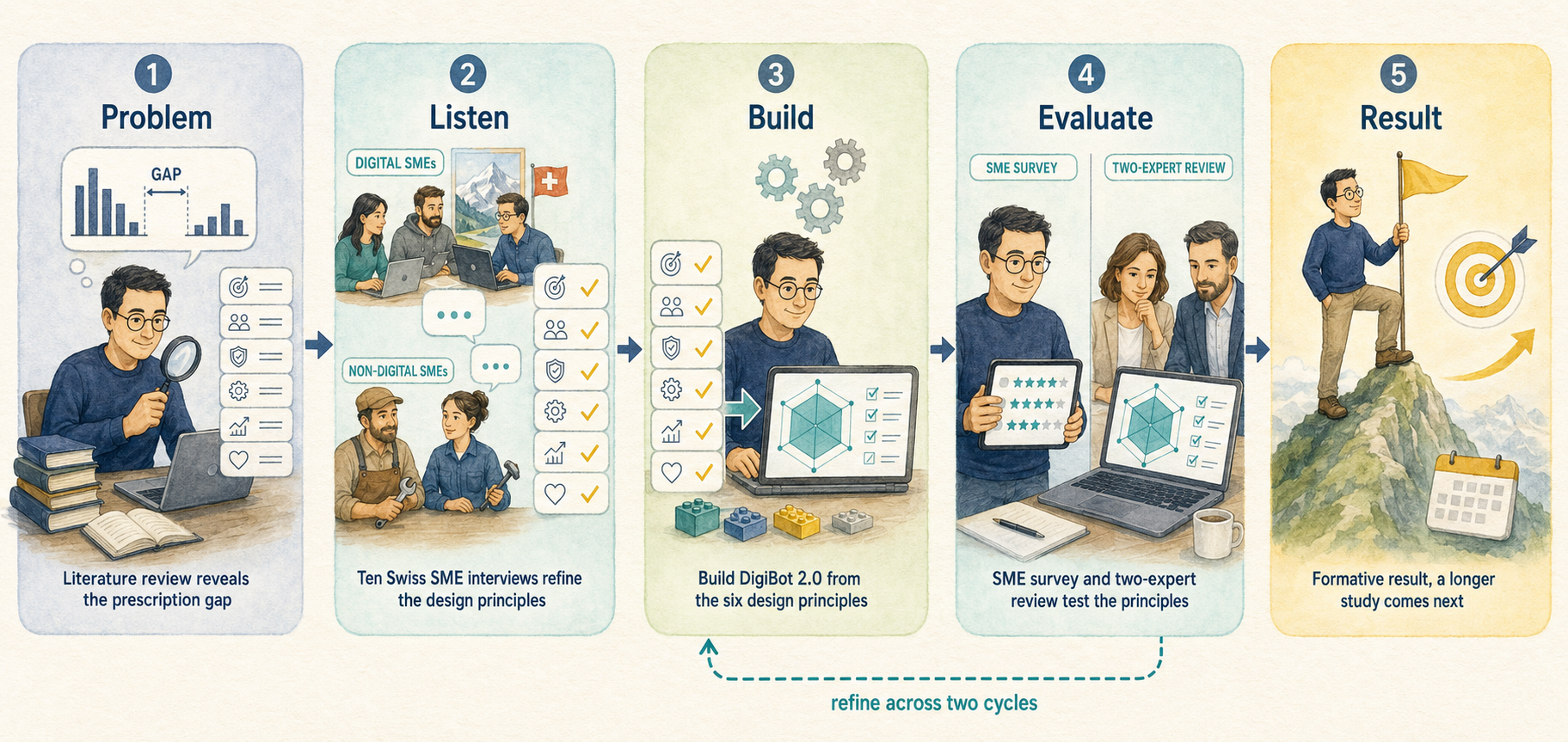
DigiBot 2.0 was built and evaluated with Design Science Research, which creates a working artifact and tests it to yield transferable design knowledge. A literature-rooted problem phase derived the first six design principles from established theory. Across two iteration loops, ten semi-structured interviews with Swiss SME managers (digital firms that could carry the service to others, non-digital firms that would use it directly) refined those principles, coded with Mayring's qualitative content analysis. DigiBot 2.0 was built from the principles, then evaluated through two channels: a short SME user survey after testing, and a two-expert validation review. The direction is confirmed, but no head-to-head comparison yet. A controlled six- and twelve-month study is the next step.