
Building Corporate Deep-Tech Capability: What Does It Take to Engage with the Next Wave of Innovation?
Topic
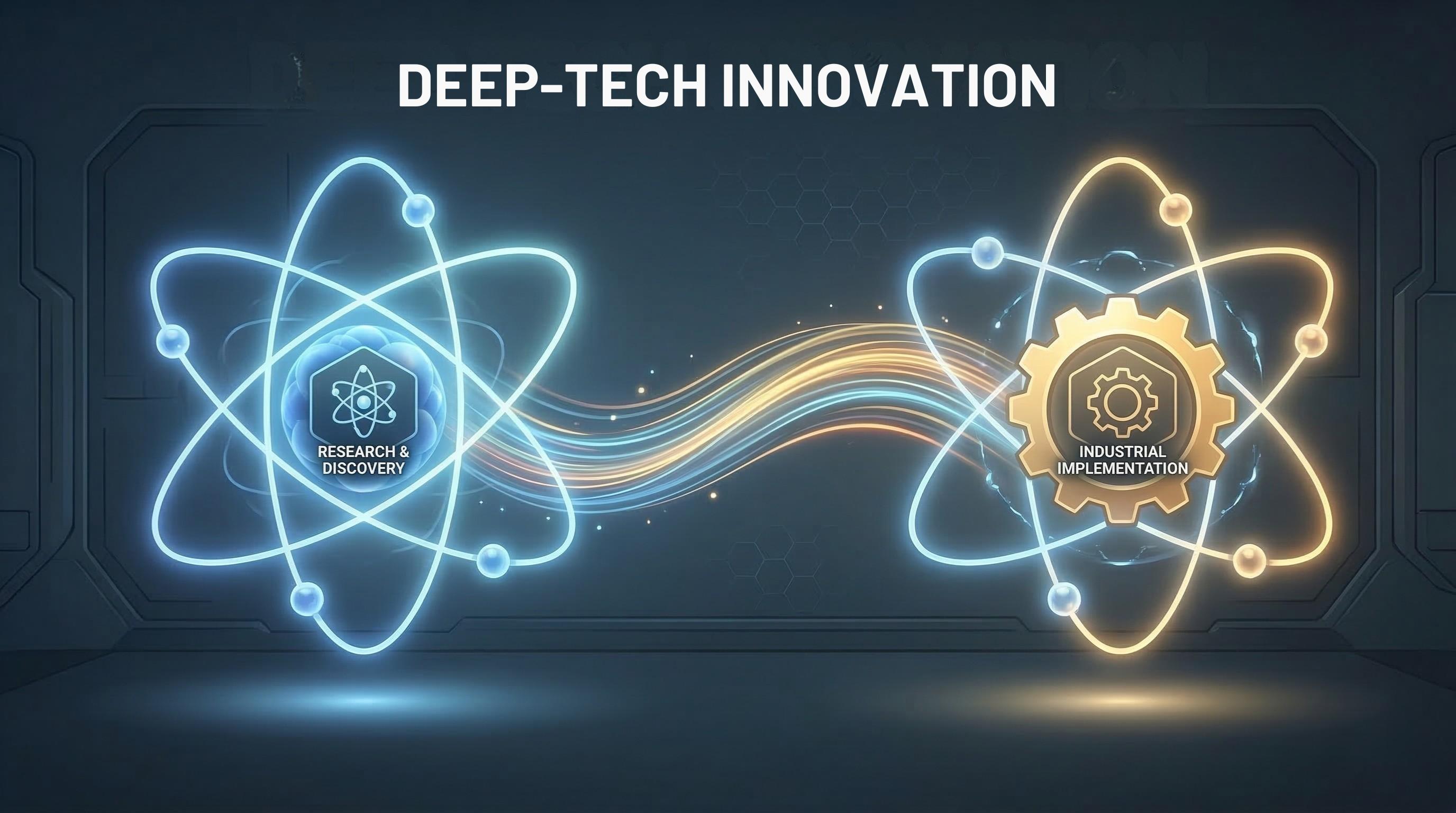
This thesis examines the organisational capabilities that established firms need to engage with deep-tech innovation. Deep Tech, characterised by scientific grounding, extended development timelines, high capital intensity and multilayered uncertainty, represents a distinct class of innovation whose strategic relevance for established firms is growing. The study identifies what capabilities constitute corporate deep-tech capability and how they can be structured and orchestrated to guide firms in their development.
Relevance
Despite the growing strategic relevance of Deep Tech, the organisational capabilities required for effective corporate engagement remain theoretically underdeveloped and practically fragmented. Existing research has focused primarily on the venture side of deep-tech development and uncovered its specific challenges, including capital intensity, technological maturity, and ecosystem access. The corporate capability dimension, meaning what established firms must be able to do to engage effectively with Deep Tech, remains largely unaddressed. Practitioners therefore lack a structured understanding of what organisational capabilities are needed to identify, evaluate, engage with, and integrate Deep Tech. This study addresses that gap and offers an empirically grounded reference point for corporate innovation managers and decision-makers.
Results
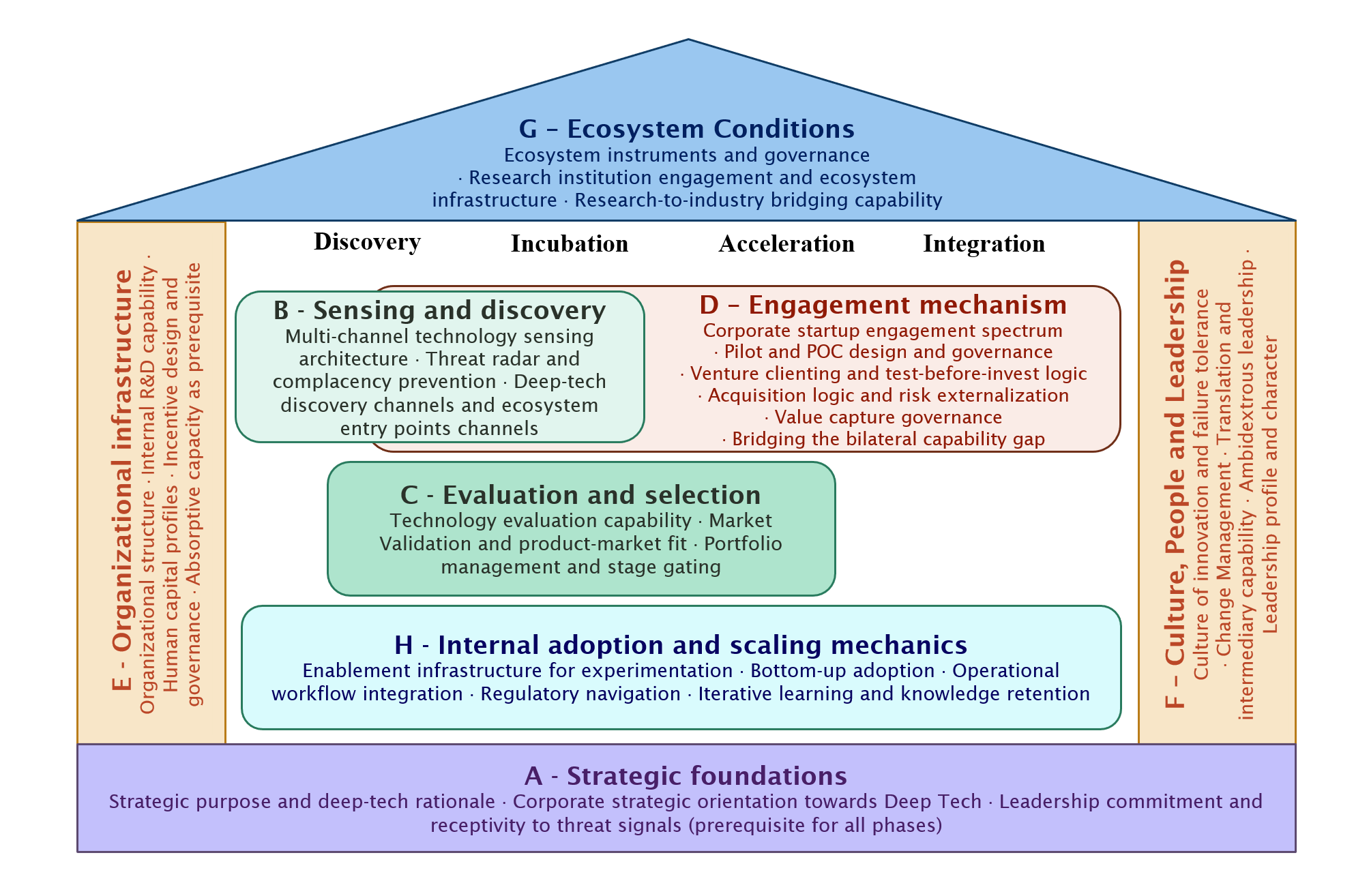
The study identifies 8 capability dimensions that define what it takes for a corporation to discover, evaluate, engage with, and integrate Deep Tech. These dimensions are structured into a capability framework, visualised as a building, because like a building, some capabilities must be in place before others can be built. Four foundational dimensions, strategic foundations, organisational infrastructure, culture and leadership, and ecosystem conditions, must be present throughout the entire journey. Four phase-sensitive dimensions, sensing and discovery, evaluation and selection, engagement mechanisms, and internal adoption and scaling, become most critical at specific points. Critically, the study finds that the primary barrier to deep-tech engagement is not financial or technological but organisational. Established firms often have the resources deep-tech ventures need. What they lack is the capability to deploy them effectively.
Implications for Practitioners
- Corporate deep-tech engagement is primarily an organisational capability challenge, not a financial or technological one. Having the budget is not enough. What separates successful from unsuccessful deep-tech engagement is the organisational capability configuration a firm has built.
- Internal R&D competence is a prerequisite for credible deep-tech engagement. Without it, firms can only engage after technological risk has been substantially reduced, which means higher cost, lower strategic influence, and in most cases outright acquisition as the only remaining option.
- Deep-tech adoption is most commonly triggered bottom-up by a passionate individual champion, and not by a top-down corporate mandate. Firms should create enabling conditions like sandboxes, psychological safety, and visible infrastructure, for these champions to surface and build the internal case for scaling.
- Public funding commitments such as European Commission grants do more than support research. Innovation leaders strategically use them to protect R&D budgets from internal cost-cutting pressure during downturns, a function that goes well beyond their intended purpose.
Methods
A qualitative exploratory research design was employed based on 12 semi-structured expert interviews with corporate innovation practitioners, deep-tech ecosystem actors, research institution representatives, venture intermediaries and deep-tech strategists across the Swiss and European context. Interview data were analysed following the Gioia methodology, this process combined abductive coding with a theoretical scaffold drawn from dynamic capabilities, corporate venturing, open innovation, open innovation in science, and responsible innovation governance research. The analysis produced 233 first-order codes that were iteratively consolidated into 33 second-order thematic clusters and aggregated into 8 overarching dimensions.