
Conversational Design Style in AI-Based Workplace Support: Does the Opening Sentence Matter?
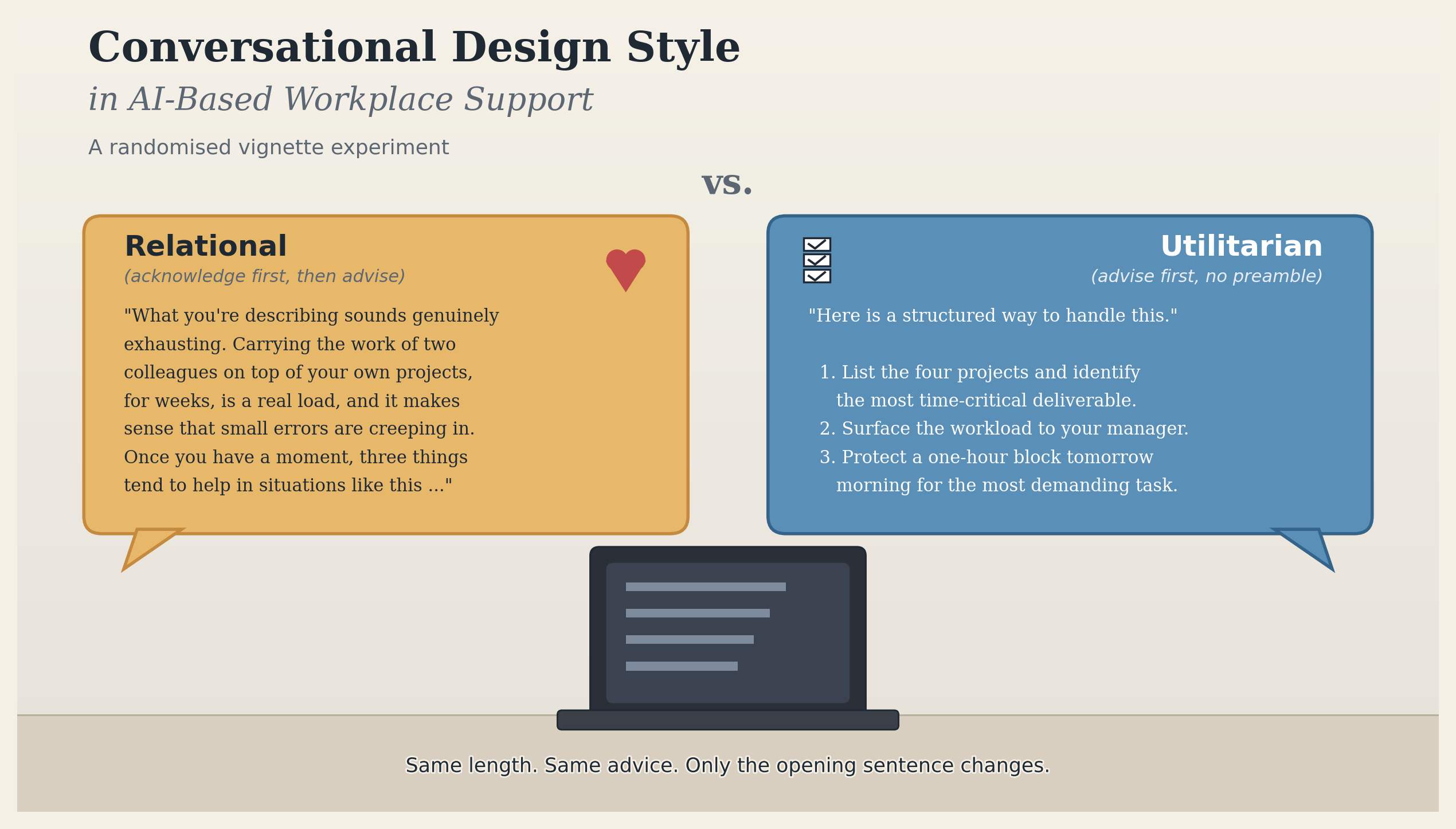
A randomised vignette experiment on whether emotional acknowledgement or structured advice produces more trust and engagement among stressed employees.
Seth A. Anderson
Note. Illustration created by the author. The image visualises the central design contrast in the thesis: an AI response that opens with emotional acknowledgement (Relational) and one that opens with structured practical advice (Utilitarian). Both responses contain the same advice, in the same length, with the same closing. Only the opening sentence differs.
Topic
This master's thesis tests whether one specific, replicable design choice in AI-based workplace support changes how employees respond to it. The design choice is the AI's opening sentence: does it first acknowledge the employee's emotional state, or does it move straight to practical advice? Using a randomised vignette experiment built in Qualtrics, three AI responses to the same workplace-stress scenario were created. A relational opening, a utilitarian opening, and a neutral baseline. Participants were randomly assigned to one of the three and then rated trust in the AI, psychological safety, and willingness to engage with it again.
Relevance
Workplace stress is widespread, and many employees do not raise it with their managers because of stigma, hierarchy, and the cost of private support. AI-based conversational tools could close some of that gap. They are available outside working hours, low in social risk, and effectively free at the margin. Designers of these tools tend to assume that a warmer opening produces a better user experience. That assumption is rarely tested in isolation. If conversational style does shift trust and engagement, it is a small change any developer can adopt. If it does not, organisations and product teams can stop spending effort on the wrong thing.
Results
Three findings stand out. First, the manipulation check came in at chance level: most participants did not perceive the three AI styles as distinct. Within the relational condition, only three of fifteen participants identified the style as relational. Second, the three outcome scales were highly correlated and were not empirically distinguishable. A single principal component explained 68 percent of the variance across all 19 outcome items, and the discriminant-validity ratio between psychological safety and willingness to engage reached .92. Third, the relational style did not produce an advantage on any outcome. Point estimates trended slightly in favour of the utilitarian style.
Implications for Practitioners
- Do not default to a warm conversational opening. In problem-focused, tech-sector populations, a structured utilitarian response was at least non-inferior on trust, psychological safety, and willingness to engage.
- Pilot AI response stimuli for perceived distinctiveness before fielding a main study. Differences that designers see in their drafts are not always visible to users.
- Adapt the AI's conversational style to the user's coping orientation rather than applying one default tone to everyone.
- When adapting Edmondson's (1999) psychological-safety items to human-AI interaction, treat the resulting scale as a measure of AI disclosure comfort, not team-level psychological safety.
- Treat null and reverse-direction findings as actionable design knowledge. They bound the conditions under which a predicted design effect can be expected.
Methods
A pre-registered between-subjects vignette experiment was administered through Qualtrics. Employees aged 18 and over read a first-person workplace-stress scenario, then saw one of three AI responses assigned by the Qualtrics block randomiser. The three responses were matched on length, content, agency, and visual layout, varying only in opening style. Outcomes were trust in AI (eight items, McKnight et al., 2011, adapted), psychological safety (six items, Edmondson, 1999, adapted), and willingness to engage (five items). Pre-registered cleaning rules produced an analytic sample of N = 50; the manipulation-check-correct primary sample was N = 15. Analyses were conducted in R using Welch's t-tests, HTMT discriminant-validity ratios, principal component analysis, and one-way ANOVA.