
Evaluating the Impact of Multi-Agent Communication Architectures on Strategic Decision-Making during Corporate Crises
This Master thesis investigates how different multi-agent artificial intelligence workflows handle complex strategic decision-making during corporate crises.
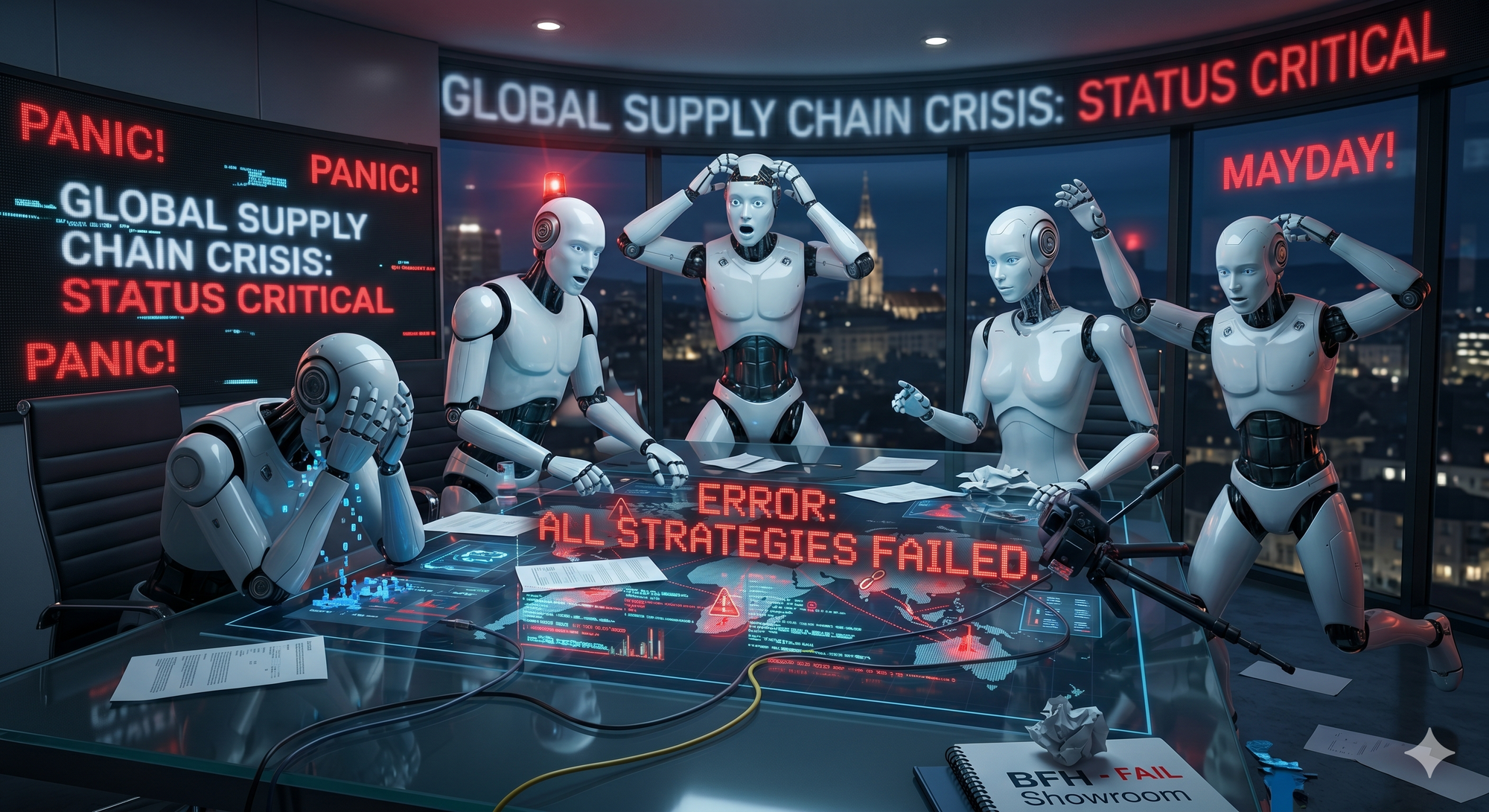
Topic
This Master thesis investigates how different multi-agent artificial intelligence workflows handle complex strategic decision-making during corporate crises. As companies increasingly rely on large language models for business strategy, it remains unclear if teamwork between AI agents actually improves output quality. The study tests five different communication architectures, including single models, sequential workflows, and boardroom debates, across various high-uncertainty business scenarios. The goal is to determine which setup produces the most reliable and realistic corporate strategy when facing severe constraints in time and capital.
Relevance
Business leaders are under immense pressure to integrate AI into their strategic processes. However, language models suffer from a various biases. For Example they tend to give polite, optimistic answers instead of making the harsh, painful cuts required for corporate survival. Practitioners need concrete evidence on whether complex multi-agent systems can overcome these biases. This study provides managers with actionable guidelines, revealing how to structure AI workflows to prevent fatal hallucinations and ensure that AI-generated strategies remain grounded in financial reality.
Results
The findings show that simply adding more AI agents does not prevent fatal strategic errors. All tested architectures failed between 60% and 77% of the time by proposing impossible solutions. However, when the AI successfully followed the rules, the communication structure mattered significantly. A sequential workflow that forced the financial agent to set a budget first produced the highest quality strategy. Conversely, a boardroom debate caused the AI to panic under time pressure, resulting in the lowest strategic quality. Interestingly, strict capital limits improved overall AI performance.
Implications for practitioners
- Human managers should still remain in control of final approvals, as AI agents actively avoid making necessary utilitarian cuts during crises.
- It could be beneficial to sequence AI tasks to establish strict financial and mathematical boundaries before allowing the AI to brainstorm operational strategies.
- Using AI debate or critique loops under severe time constraints might not be optimal, as excessive feedback causes analysis paralysis and lowers strategy quality.
- Use AI primarily as an idea-generation tool rather than an autonomous decision-maker for high-stakes business problems.
Methods
The study used a quantitative experimental design. A base scenario involving a manufacturing supply chain crisis was modified using three variables: capital, time, and competition. This created eight distinct crisis states. Five different AI communication architectures generated solutions for each state, resulting in 200 unique corporate strategies. These strategies were evaluated by a panel of three advanced language models acting as judges. The judges used a behaviorally anchored rating scale to score strategic coherence, financial feasibility, and risk integration. The data was analyzed using a two-stage hurdle model, combining Chi-Square tests for failure rates and Kruskal-Wallis tests for strategic quality.