
Reforesting the Mind: Assessing the Impact of Mindful Forest Walking in the Workplace
Reforesting the Mind: Assessing the Impact of Mindful Forest Walking in the Workplace
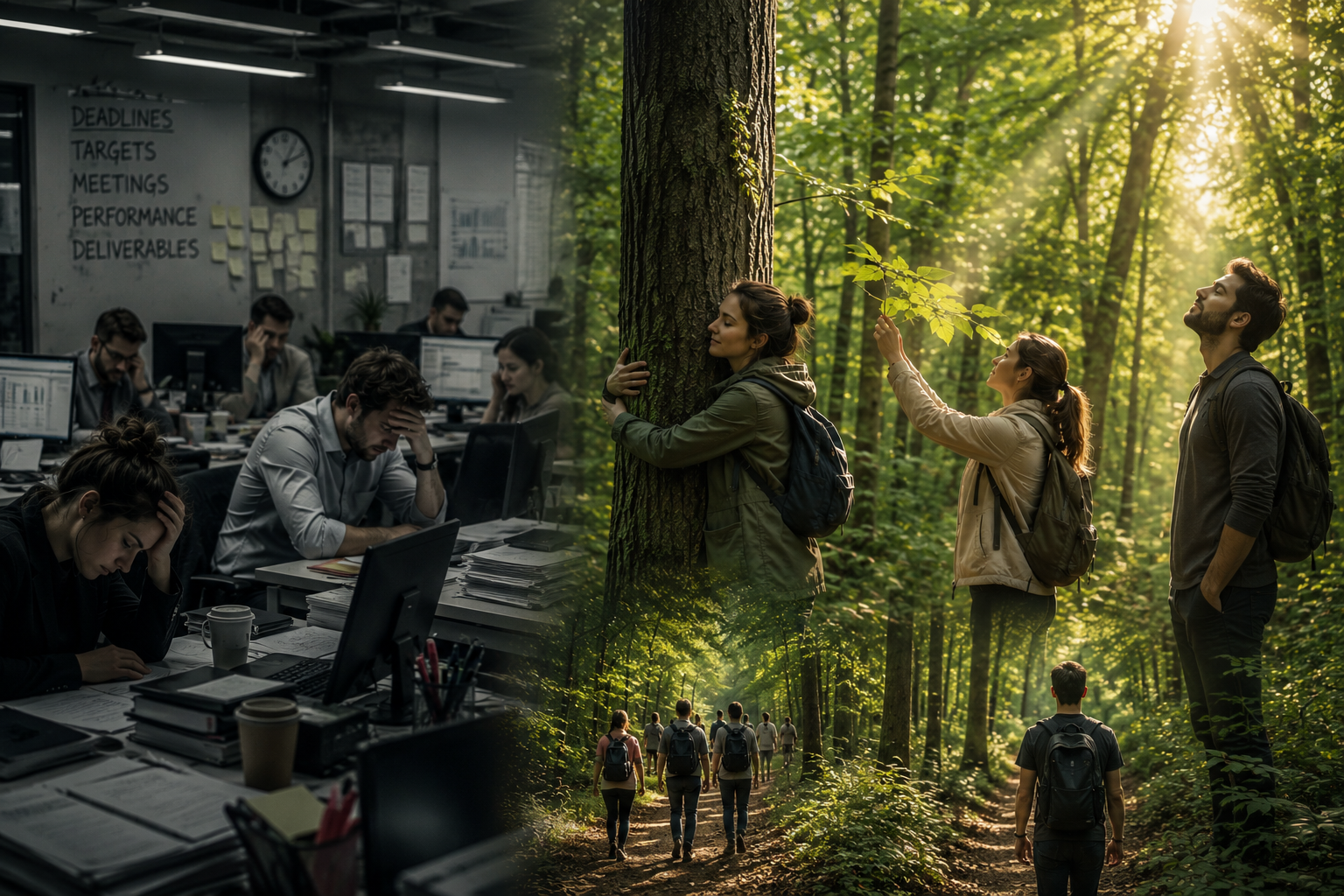
Topic
Modern workplaces are demanding, always connected, and rarely designed for genuine recovery. This thesis examines whether something as simple as a thirty-minute mindful forest walk during a lunch break can make a meaningful difference. Drawing on the Japanese practice of shinrin-yoku “forest bathing” the study explores how Swiss knowledge workers experience weekly mindful forest walking as a structured recovery practice during the workday, and whether it supports perceived restorativeness from work-related stress and cognitive fatigue.
Relevance
Burnout, chronic stress, and cognitive exhaustion are growing challenges in knowledge-intensive work environments. Organizations are investing in wellness programs — apps, workshops, digital tools — but many of these happen outside the workday and fail to address fatigue when it builds. This study is relevant because it examines a minimal, low-cost, accessible recovery practice that fits inside the working day itself. No trainer required. No equipment. Just a nearby green space and thirty minutes.
Results
73% of participants experienced meaningful felt restorativeness after weekly mindful forest walks. 86% initially struggled to detach from work — but 84% showed clear progressive improvement across four weeks. Present-moment awareness appeared in 81% of participants, stress reduction in 70%, and 68% continued the practice voluntarily after the study ended. A striking finding was that many participants did not just feel better — they discovered hidden stress they had not previously acknowledged, through the act of trying to slow down.
Implications for practitioners
- Meaningful recovery can be achieved in thirty minutes which means organizations do not need expensive programs to support employee well-being during the workday; a nearby green space and a structured invitation to walk mindfully is enough.
- Four weeks is the minimum — a single session produces limited results. Organizations should frame mindful forest walking as a multi-week commitment and encourage employees to try it for at least three to four consecutive weeks before evaluating its impact.
- Initial skepticism does not predict outcome - almost everyone who started doubtful ended up appreciating the practice. Employee resistance at the start should not discourage organizational introduction.
- Offer both group and solo formats. Group walks support social connection and team cohesion; solo walks support deeper cognitive restoration. Both have value and serve different needs.
- The practice works even in performance-oriented cultures — this study was conducted with Swiss knowledge workers in a high-efficiency work culture. The restorative effects appeared despite cultural resistance, suggesting the practice is transferable across cultural contexts.
Methods
This study used a qualitative research design, drawing on deductive-inductive content analysis following Mayring (2014). Data consisted of 37 reflective reports submitted by knowledge workers enrolled in a Master's program at the Bern University of Applied Sciences, who engaged in weekly mindful forest walks over four weeks. Submissions were collected in three formats — written reports, video reflections, and illustrated reflections — and coded systematically in Taguette across four analytical dimensions: Psychological Restoration, Sensory and Body Engagement, Perceived Restorativeness, and Contextual Factors. A supplementary computational text analysis was conducted using ChatGPT-4o to cross-validate the qualitative findings through word frequency and sentiment tracking.