
Simulating the Patient: Acceptance of a Conversational AI Tool for Communication Training Among Healthcare Apprentices
This thesis looks at how healthcare apprentices, respond to an AI virtual patient used for communication training.
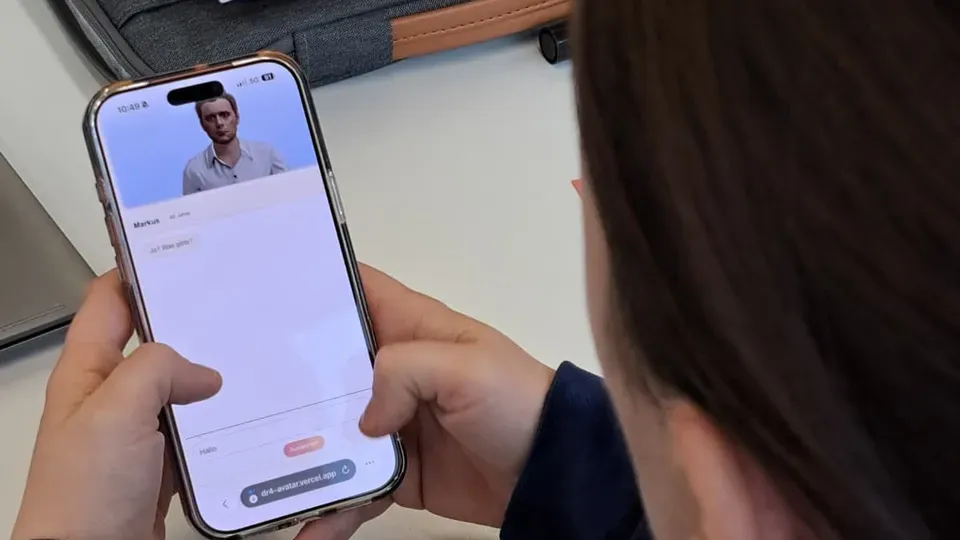
Topic
This thesis looks at how healthcare apprentices (Fachfrau/mann Gesundheit), respond to an AI virtual patient used for communication training. The tool is a custom web application that presents the patient shown above. For about twenty minutes, first-year apprentices speak with her by voice and practise a difficult conversation in a safe setting, with no risk to a real patient. Straight afterwards, the application gives written feedback on how the conversation went. The study asks a clear question: do the apprentices accept the tool, and would they use it again?
Relevance
Communication is one of the most important skills for FaGe apprentices, and one of the most difficult to train. Simulated patients are very costly expensive and a difficult conversation is risky to rehearse with someone who is unwell. Three groups carry this responsibility. Inter-company course providers (ÜK-Anbieter) run the shared modules where communication is taught. Training companies (Lehrbetriebe) and apprenticeship trainers (Berufsbildner) support the apprentices in their daily work. All of them need training methods that are effective and that the apprentices will use. This study gives them evidence on acceptance before they commit time and resources for an AI virtual patient.
Results
Acceptance was high. Seven of the eight hypotheses were supported. The apprentices found the tool easy to use and useful, and they intended to use it again. Trust was central, and it came mainly from security: the apprentices trusted the tool when they felt their data was safe. The most unexpected result concerned privacy. Privacy had no measurable effect on trust. The likely explanation lies in the design, because the patient was simulated and the apprentices shared no personal information, so privacy concerns did not come into play.
Implications for practitioners
• Inter-company course providers can add the AI virtual patient to their existing communication modules without resistance from the apprentices. When introducing it, the focus should be on the communication skills the apprentices will gain, not on the technology.
• The same approach can be transferred to other service occupations with frequent client contact, such as retail, hospitality, or customer service.
• Training companies and apprenticeship trainers should not assume that privacy is unimportant. Privacy played a minor role here only because the patient was fictional. With real cases or personal reflections, privacy becomes important again.
Methods
The study used a quantitative, cross-sectional survey, which means the data was collected once, immediately after each apprentice used the tool. The AI simulation was integrated into the inter-company course (üK), so that every apprentice worked through the same scenario under the same conditions. Each apprentice spent about twenty minutes with the virtual patient and then completed a questionnaire on Qualtrics using 7-point scales. The analysis was based on an extended Technology Acceptance Model (TAM), which adds trust, security, and privacy to the established factors of perceived ease of use and usefulness. The final sample comprised 262 first-year apprentices.