
Technostress Among Female Working Students
This study examines how digital flexibility and constant connectivity affect female working students balancing work and university life.
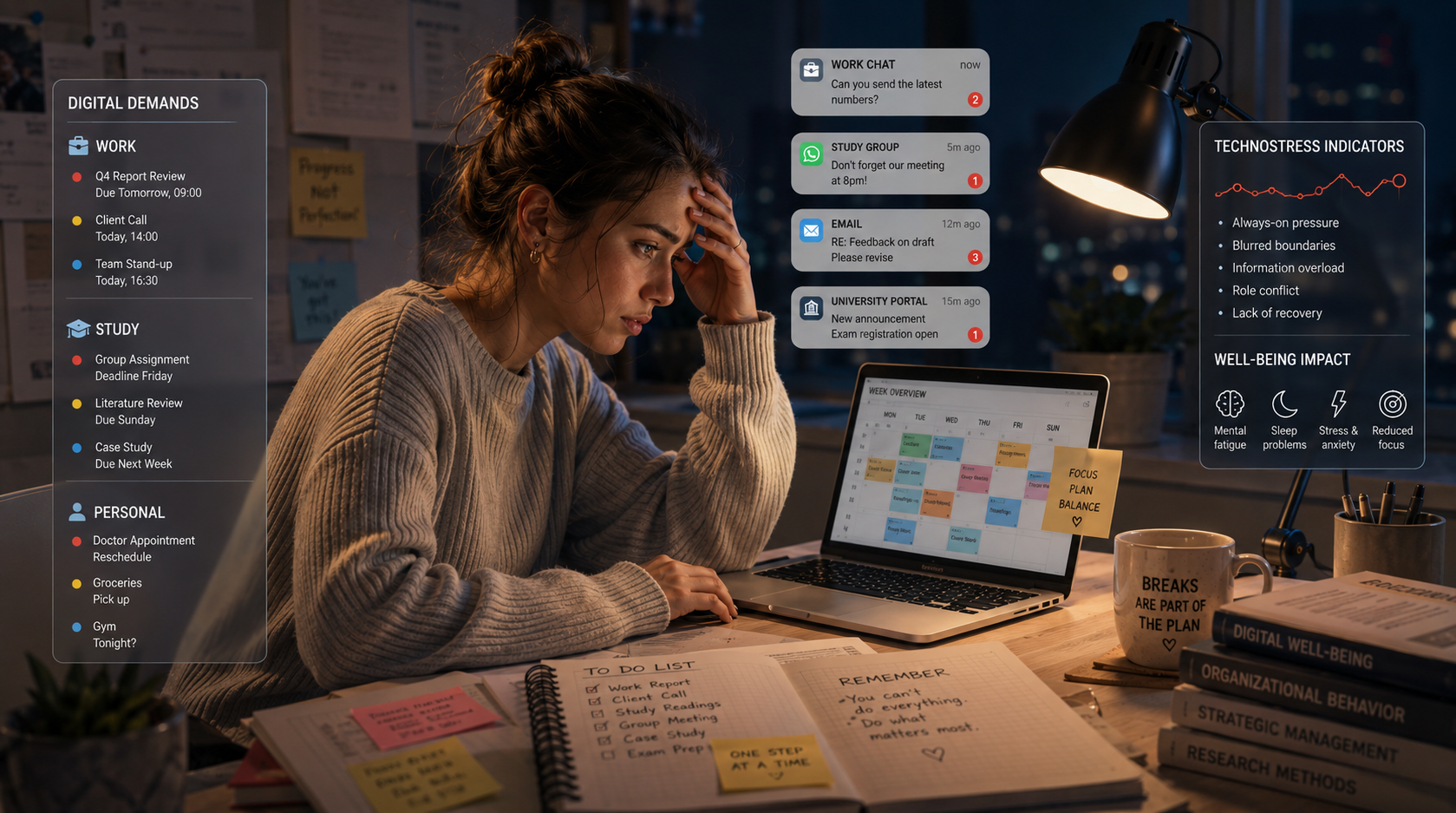
This study explores how female working students in business-related fields at Swiss universities of applied sciences experience technostress caused by digital flexibility and constant connectivity. Digital tools make it easier to combine work and study, but they also blur the boundaries between professional, academic, and personal life. The study focuses on female working students because they manage digital demands from both work and university simultaneously and may therefore experience increased pressure and stress.
Relevance
Hybrid work and digital learning have become increasingly common in both organizations and universities. In Switzerland, many students combine higher education with paid employment, yet the challenges of constant digital connectivity are often underestimated. This study is relevant for organizations, managers, HR professionals, and universities because it highlights how ongoing availability expectations can negatively affect well-being, role balance, and recovery among working students.
Results
The findings show that digital flexibility was experienced as both helpful and stressful at the same time. Participants appreciated the flexibility digital tools provided, but also felt pressure to remain constantly available. Connectivity pressure was often self-imposed, as many participants expected themselves to respond quickly even without explicit demands from others. Participants also described experiences of information overload, difficulties disconnecting from work and study, and challenges balancing multiple roles. Physical boundary strategies, such as using separate devices or limiting notifications, were perceived as particularly helpful for reducing stress.
Implications for Practitioners
- Managers should communicate clearly when messages require immediate responses and when they can wait.
- Universities should simplify digital communication and establish clearer expectations regarding response times in group work.
- Working students may benefit from separating work and study devices or limiting notifications to create clearer boundaries.
- Constant digital flexibility should not automatically be treated as purely positive, as it may also increase expectations of availability and responsiveness.
- Self-imposed pressure to stay constantly connected should receive greater attention, as participants often experienced stronger pressure from themselves than from others.
Methods
This study used a qualitative research design to explore the experiences of female working students. Twelve semi-structured interviews were conducted with students enrolled in business-related Bachelor’s and Master’s programmes at Swiss universities of applied sciences. Participants discussed their experiences with digital flexibility, availability expectations, and technostress in both work and study contexts. The interview data were analysed using reflexive thematic analysis following Braun and Clarke (2006).